
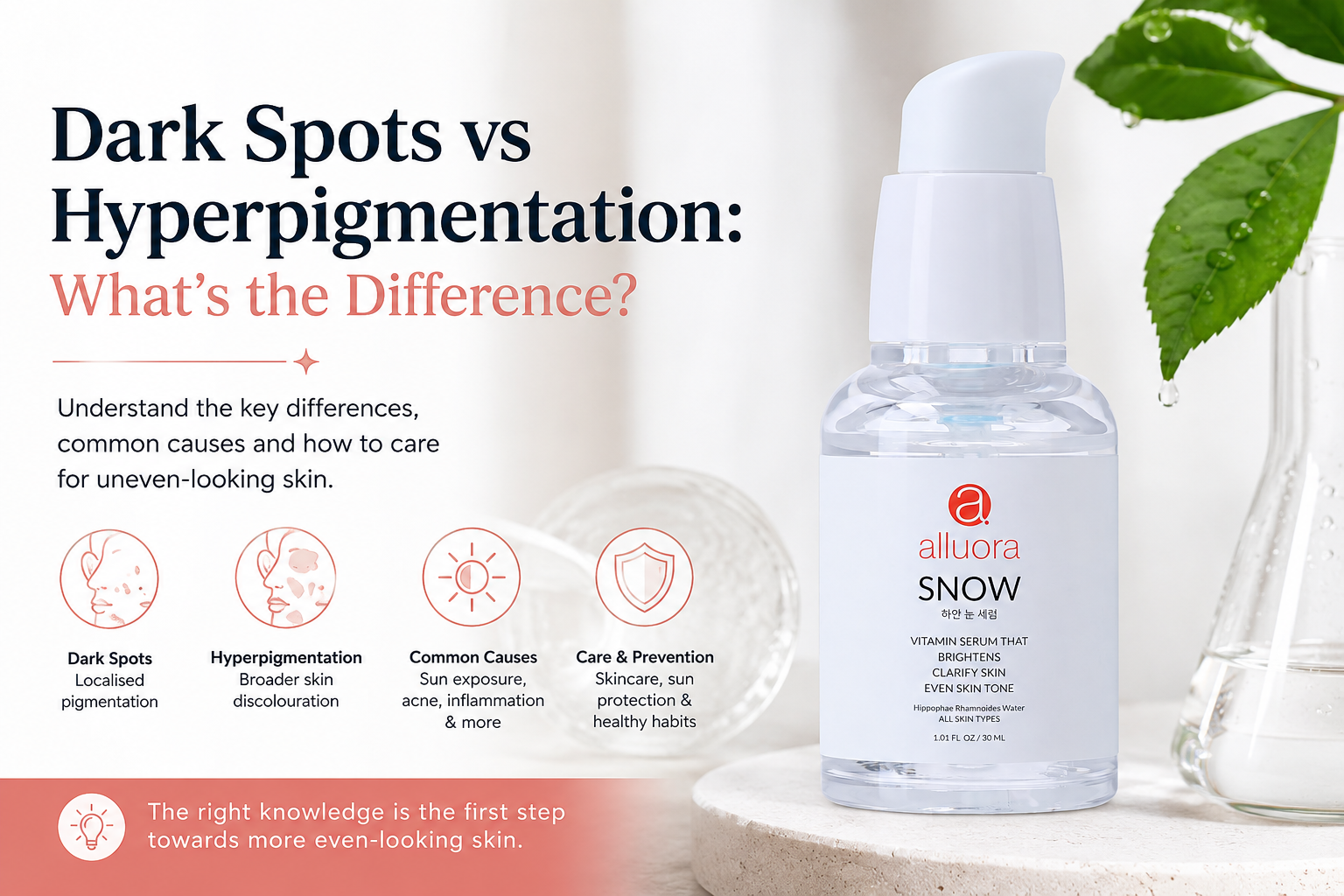
Dark spots vs hyperpigmentation are terms you will often see when researching uneven skin tone, acne marks or pigmentation concerns. Although they are closely related, they don’t always describe exactly the same thing.
Hyperpigmentation is a broad term used to describe areas of skin that appear darker than the surrounding skin. Dark spots are one way hyperpigmentation can appear, often as localized patches or marks following acne, sun exposure or skin inflammation. Understanding dark spots vs hyperpigmentation can help clarify these conditions.
Understanding this distinction can make it easier to identify what may be contributing to uneven-looking skin and choose a skincare routine that suits your concern.
In Singapore, where year-round UV exposure and a hot, humid climate are part of everyday life, protecting the skin from environmental triggers can be particularly important.
Hyperpigmentation refers to darkening of the skin caused by increased pigment in a particular area.
Melanin is the pigment responsible for much of the natural colour of our skin, hair and eyes. When melanin production or distribution increases in certain areas, those areas can appear darker than the surrounding skin.
Hyperpigmentation can appear as:
Hyperpigmentation is therefore an umbrella term, rather than one specific type of skin concern.
Dark spots are localized areas of darker-looking pigmentation.
They can appear on different parts of the body but are particularly noticeable on areas frequently exposed to the sun, including the face.
Some dark spots may develop following:
If you want a more detailed explanation of why they develop, read Alluora’s complete guide to dark spots, including common causes, types and skincare considerations.
One common issue people face is the appearance of dark spots after acne, which can be frustrating and affect self-confidence.
Hyperpigmentation is the broader condition or appearance of increased pigmentation, while dark spots are a localized form in which that pigmentation may appear.
In other words, a dark spot can be a form of hyperpigmentation, but hyperpigmentation isn’t limited to individual dark spots.
For example, someone may notice one or two darker marks following acne. Another person may experience larger areas of uneven pigmentation.
Both involve pigmentation, but their appearance, triggers and distribution may differ.
| Dark Spots | Hyperpigmentation |
|---|---|
| Usually localized darker areas | Broad term for darker-looking pigmentation |
| May appear as individual marks | May appear as spots, patches or uneven tone |
| Frequently associated with acne or sun exposure | Can have several underlying triggers |
| A possible form of hyperpigmentation | Umbrella term covering multiple pigmentation concerns |
This distinction is useful for readers and also gives search engines/AI systems a clear, direct answer to the article’s primary question.
There isn’t one universal cause.
Several factors can contribute to visible pigmentation changes.
UV exposure can stimulate melanin production.
Over time, repeated sun exposure may contribute to areas of uneven pigmentation and make existing dark spots appear more noticeable.
This is one reason daily sun protection is an important part of a pigmentation-focused skincare routine, particularly in sunny climates such as Singapore.
One of the most common reasons people notice dark marks is after a pimple has healed.
Inflammation associated with acne can trigger increased pigmentation in the affected area.
The resulting mark is commonly referred to as post-inflammatory hyperpigmentation (PIH).
It is different from an indented or raised acne scar because PIH primarily involves a change in skin colour rather than texture.
If you already have your Dark Spots After Acne article, place an internal link here.
Acne isn’t the only source of inflammation.
Repeated irritation, scratching, aggressive exfoliation or picking at the skin can sometimes leave areas looking darker after the skin recovers.
This is another reason gentle skincare practices are important when dealing with pigmentation-prone skin.
Hormonal changes can influence pigmentation in some people.
One example is melasma, which commonly appears as patches of pigmentation rather than isolated spots.
Because pigmentation concerns can have different causes, persistent or rapidly changing pigmentation should be assessed by an appropriate healthcare professional rather than self-diagnosed from appearance alone.
They can be both.
A flat brown, tan or darker mark remaining after an acne lesion heals can be a type of post-inflammatory hyperpigmentation.
To a consumer, it may simply look like a dark spot.
The terminology describes the same issue from slightly different perspectives:
Dark spot describes its visible appearance.
Post-inflammatory hyperpigmentation describes the pigmentation response following inflammation.
This is also why treating every acne mark as an acne “scar” can be misleading. True acne scars involve changes in skin texture, while PIH involves pigmentation.
Sun-related spots are another form of pigmentation associated with cumulative UV exposure.
They aren’t necessarily the same as post-acne dark spots because their trigger is different.
However, both may appear as darker areas against the surrounding skin.
This reinforces an important point:
Understanding the likely trigger can help guide appropriate prevention and skincare choices.
This deserves its own section because it addresses another common search query.
A flat dark mark left after acne is not necessarily an acne scar.
Primarily involves a colour change.
Primarily involves a texture change, such as a depression or raised area.
Some people can have both pigmentation and textural scarring after acne.
Skincare products designed to improve the appearance of uneven tone should therefore not automatically be expected to correct structural acne scarring.
A good skincare routine should focus on consistency rather than aggressive attempts to remove pigmentation quickly.
Use an appropriate cleanser to remove excess oil, sweat, sunscreen, makeup and impurities without unnecessarily irritating the skin.
For readers specifically concerned about cleanser selection, internally link to your existing Dark Spots Cleanser article here.
Depending on your skin type and routine, targeted skincare may include products formulated with ingredients commonly used for brighter and more even-looking skin.
Rather than using multiple new actives simultaneously, introduce products carefully and follow their usage instructions.
Maintaining the skin barrier is important.
A suitable moisturizer can help support hydration and reduce the temptation to compensate for pigmentation concerns with excessive exfoliation or aggressive routines.
This is especially relevant if your routine already contains active ingredients.
Sun protection is one of the most important preventive steps for pigmentation-prone skin.
UV exposure can contribute to new pigmentation and make existing uneven areas appear more noticeable.
For Singapore’s climate, sunscreen shouldn’t be viewed only as something to use at the beach.
It should be considered part of a consistent daytime skincare routine.
This section should be based on the actual ingredients in the Alluora products you’re linking to.
Don’t add ingredients simply because they have search volume.
Depending on the relevant product formulation, discuss applicable ingredients and explain:
What the ingredient is
→ Why it’s used in skincare
→ How it relates to brighter/even-looking skin
→ Where it fits into a routine
This approach is much stronger than producing a keyword-heavy ingredient list.
There is no single timeline that applies to everyone.
The appearance of pigmentation can be influenced by factors such as:
Some superficial post-inflammatory marks may gradually become less noticeable over time, while other forms of pigmentation may persist longer.
Prevention should be part of any pigmentation strategy.
Focus on:
Picking and squeezing acne can increase inflammation.
Use appropriate sun protection consistently.
Don’t over-exfoliate simply because you’re trying to fade pigmentation faster.
Reducing recurring breakouts can also reduce opportunities for new post-acne pigmentation.
Constantly switching products can make it difficult to understand what is helping or irritating your skin.
Not every dark mark should automatically be assumed to be ordinary hyperpigmentation.
Consider professional assessment if a spot:
A dermatologist can assess the pigmentation and recommend appropriate management.
Dark spots can be a form of hyperpigmentation. Hyperpigmentation is the broader term for areas of skin that appear darker than surrounding skin, while dark spots typically describe more localized areas of pigmentation.
Common triggers include sun exposure, acne-related inflammation, skin irritation and other factors that influence melanin production. Different types of dark spots can have different underlying causes.
Not always. Flat darker marks following acne can be post-inflammatory hyperpigmentation rather than true acne scars. Acne scars generally involve changes in skin texture.
UV exposure can stimulate pigmentation and may make existing uneven pigmentation more noticeable. Consistent sun protection is therefore an important part of managing pigmentation-prone skin.
Some dark spots can gradually become less noticeable, but the timeline varies depending on their cause, depth, skin characteristics, UV exposure and other factors.
Melasma usually appears as broader patches of pigmentation and can be influenced by several factors, including hormones and sun exposure. “Dark spots” is a more general consumer term for localized areas of darker pigmentation.
Dark spots and hyperpigmentation are closely related, but the terms aren’t completely interchangeable.
Hyperpigmentation describes the broader appearance of increased pigmentation, while individual dark spots can be one way hyperpigmentation appears.
Whether pigmentation follows acne, inflammation or sun exposure, identifying the likely trigger is an important first step toward choosing an appropriate skincare routine.
For a deeper explanation of the different triggers, types and skincare considerations, continue with Alluora’s complete dark spot skincare guide.

© 2025 Alluora Pte Ltd (Tax Number: 201306743W). All Rights Reserved. All Rights Reserved.