
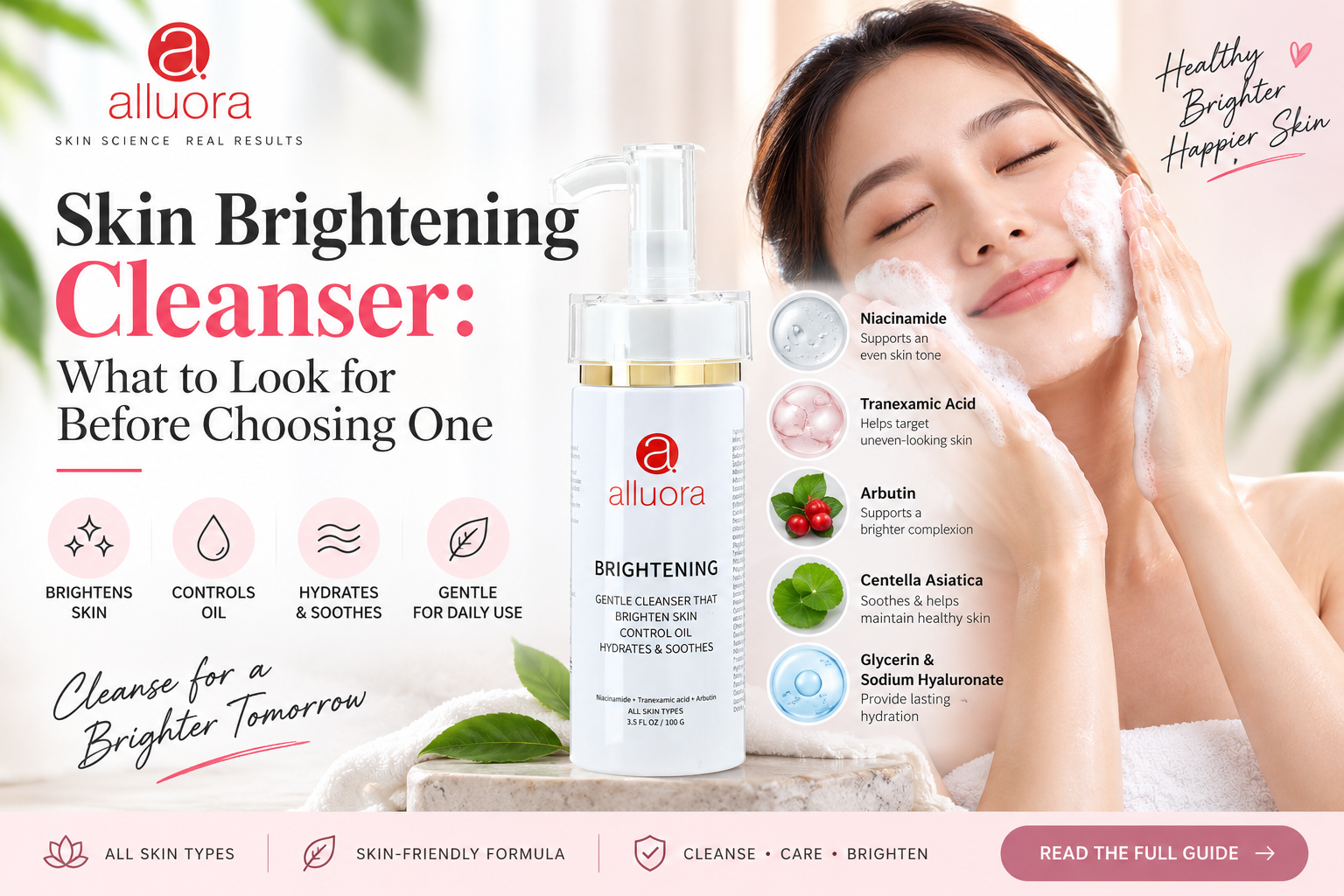
Cleansing is the first step in most skincare routines, but not every facial cleanser is designed with exactly the same goal.
A regular cleanser primarily helps remove excess oil, sweat, sunscreen, makeup residue and everyday impurities from the skin. A brightening cleanser performs the same essential cleansing role but may also contain ingredients selected to support a brighter, fresher and more even-looking complexion.
So, should you use a brightening cleanser or stick with a regular facial cleanser?
The answer depends on your skin concerns, the product’s formulation and the rest of your skincare routine.
Here is a practical comparison.
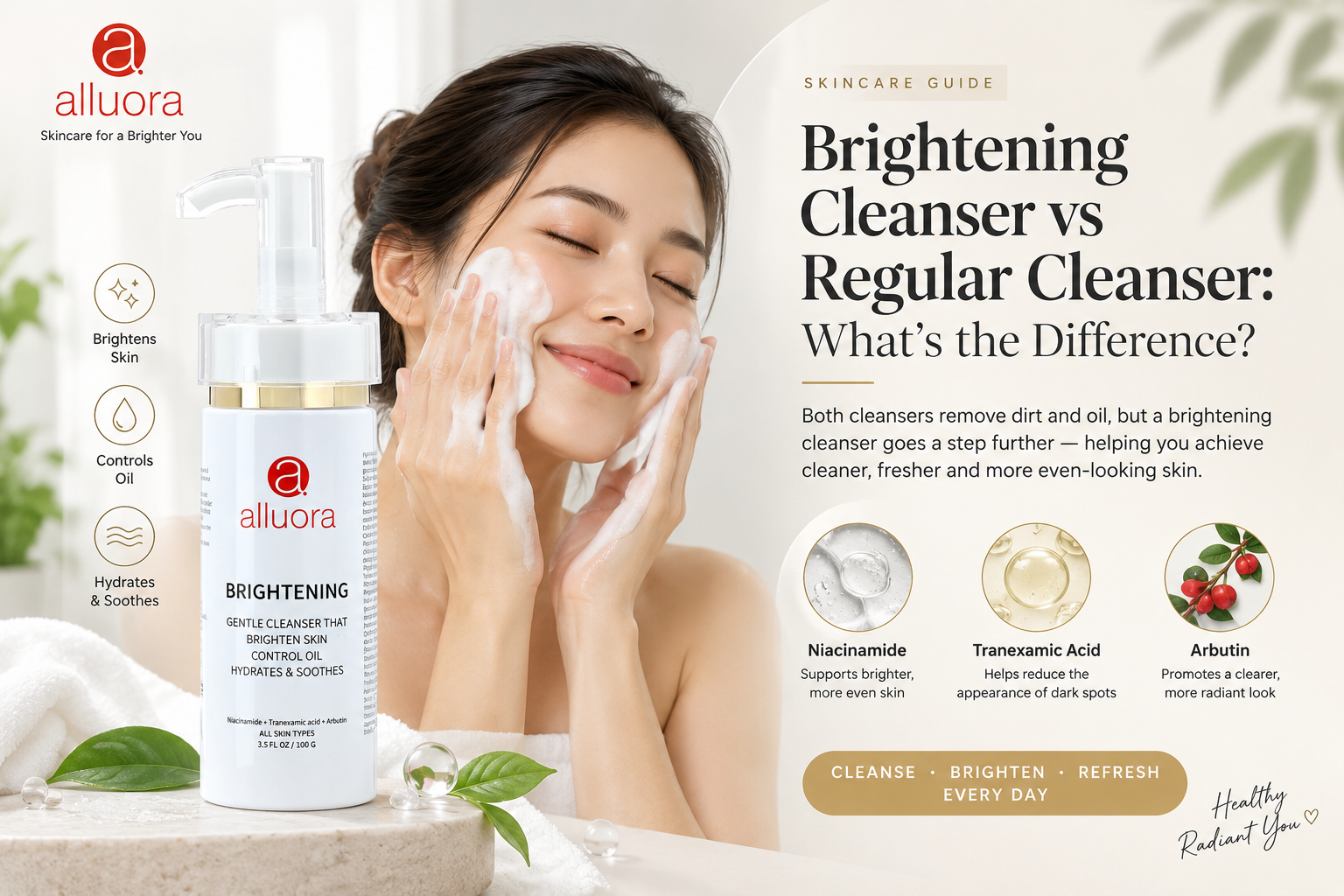
A regular facial cleanser is primarily formulated to clean the skin without unnecessarily disrupting its natural barrier.
Depending on the formulation, it can help remove:
Different cleansers are designed for different skin types. For example, someone with oily skin may prefer a lightweight gel cleanser, while someone with dry or sensitive skin may look for a gentler, more hydrating formulation.
The main objective, however, remains cleansing.
A brightening cleanser combines everyday cleansing with ingredients or formulation features intended to support skin that looks dull, tired or uneven.
It still needs to perform the fundamental job of a cleanser: removing impurities from the skin.
The difference is that a brightening formula may also be designed around concerns such as:
Dull-looking skin
Uneven-looking skin tone
Post-acne marks
Visible pigmentation
Loss of radiance
However, a cleanser is a rinse-off product. It generally has much less contact time with the skin than a leave-on serum, essence or moisturizer.
For that reason, a brightening cleanser should usually be viewed as the first step in a complete brightening routine, rather than as a replacement for every other brightening product.
Here is the simplest comparison:
| Feature | Regular Cleanser | Brightening Cleanser |
|---|---|---|
| Removes dirt and impurities | Yes | Yes |
| Removes excess oil | Yes | Yes |
| Supports daily cleansing | Yes | Yes |
| Targets dull-looking skin | Not necessarily | Often |
| Designed around uneven-looking tone | Not necessarily | May be |
| Contains targeted brightening ingredients | Not necessarily | Depending on formulation |
| Can be part of a brightening routine | Yes | Particularly suitable |
| Replaces a serum | No | No |
The key distinction isn’t that one cleans and the other doesn’t.
Both are cleansers.
The difference lies mainly in the additional skin concerns the formulation is designed to address.
If your face is clean but still doesn’t look as radiant as you’d like, cleansing alone may not address the underlying reason.
Several factors can contribute to a dull or uneven appearance, including accumulated dead surface cells, dryness, sun exposure, post-inflammatory pigmentation and an unsuitable skincare routine.
Singapore’s hot and humid conditions can add another consideration. Sweat, sunscreen, sebum and environmental impurities can accumulate throughout the day, making effective but appropriate cleansing an important part of a daily routine.
However, aggressively cleansing the skin isn’t the solution.
Over-cleansing or using an unsuitable formula can leave skin feeling tight or uncomfortable.
The objective should be to clean effectively while supporting the skin barrier and addressing your individual concerns through the rest of the routine.
The ingredient list is more useful than simply seeing the word “brightening” on the front of a product.
Depending on the formulation, brightening skincare may incorporate ingredients selected to support a more even and radiant appearance.
When evaluating any cleanser, also consider the complete formula, not just one highlighted ingredient.
A good cleanser needs to work as a cleanser first.
It should remove daily impurities effectively without leaving your skin feeling excessively stripped.
For more persistent concerns such as visible pigmentation or post-acne marks, leave-on skincare may play a larger role because it remains in contact with the skin longer.
Not necessarily.
Brightening and exfoliating are related concepts, but they are not interchangeable.
An exfoliating cleanser is specifically formulated to help remove or loosen dead surface skin cells, depending on the exfoliating ingredients it contains.
A brightening cleanser is a broader category. Its formulation may support a brighter-looking complexion through different mechanisms and ingredients.
Some products may offer both properties.
That is why you should assess the actual formula instead of assuming that every product labelled “brightening” is also an exfoliator.
A brightening cleanser may be worth considering if your primary skincare concerns include:
It can also be useful for someone who already uses brightening serums or moisturizers and wants their cleanser to complement the same overall skincare goal.
However, your skin type still matters.
Look for effective cleansing without making the skin feel excessively dry or tight.
Prioritize a formula that doesn’t leave your skin feeling stripped after washing.
Pay particular attention to the complete ingredient list and introduce new products carefully.
Choose products appropriate for acne-prone skin and avoid assuming that stronger cleansing will automatically produce better results.
Whether a brightening cleanser is suitable for daily use depends on its formulation and your skin’s tolerance.
A gentle cleanser formulated for routine use may fit comfortably into a daily skincare regimen.
However, if a product contains stronger exfoliating ingredients, frequency may need to be adjusted based on the product instructions and how your skin responds.
Signs that a cleanser may not be working well for you include persistent tightness, excessive dryness, stinging or visible irritation.
More frequent cleansing does not necessarily mean faster brightening.
Consistency with a well-balanced routine is more important than aggressive use.
A suitable cleanser can potentially be used in either routine, depending on its formulation and your skin’s needs.
Cleansing can help remove overnight oil, sweat and residue before applying the rest of your morning skincare.
A typical routine might be:
Cleanser → Toner/Essence → Serum → Moisturizer → Sunscreen
Evening cleansing becomes particularly important for removing sunscreen, excess oil, pollutants and other impurities accumulated during the day.
A routine might look like:
Cleanser → Toner/Essence → Treatment Serum → Moisturizer
If you wear heavier makeup or water-resistant sunscreen, your cleansing requirements may differ.
This is an important distinction.
A cleanser is primarily a rinse-off product.
A serum is normally a leave-on treatment.
This means they perform different jobs within the skincare routine.
A brightening cleanser can establish the cleansing foundation of your routine, while an appropriately formulated serum can provide leave-on ingredients targeted toward specific concerns.
Therefore:
A brightening cleanser and a brightening serum should generally be viewed as complementary steps rather than interchangeable products.
You don’t necessarily need a complicated multi-product routine, but expecting a cleanser alone to perform every function of leave-on skincare is unrealistic.
Singapore’s climate can influence how skin feels throughout the day.
Heat and humidity can contribute to sweat and oil accumulation, while regular sunscreen use means effective evening cleansing is particularly important.
When choosing a facial cleanser, consider:
1. Your skin type
Oily, combination, dry and sensitive skin may respond differently to the same formulation.
2. Your main skin concern
Are you primarily concerned about oil, dullness, visible dark spots, uneven tone or sensitivity?
3. The complete ingredient list
Don’t choose a product based only on a single hero ingredient.
4. How your skin feels after cleansing
Skin should feel clean, not unnecessarily stripped.
5. Your complete routine
Your cleanser should complement rather than conflict with your serum, moisturizer and other skincare products.
Think of cleansing as the foundation.
A straightforward routine could look like this:
Remove excess oil, sweat, sunscreen and daily impurities.
Depending on your routine, follow with a toner or essence.
A serum can address specific concerns with ingredients that remain on the skin.
Support hydration and the skin barrier.
Finish your morning routine with appropriate sun protection.
This is especially relevant when your goal is to manage the appearance of uneven pigmentation because ongoing UV exposure can work against a brightening-focused routine.
Neither category is automatically “better.”
The right choice depends on what your skin needs.
If your primary goal is simply removing everyday oil and impurities, an appropriate regular cleanser may be enough.
If you’re also concerned about dullness or uneven-looking skin tone, a well-formulated brightening cleanser may better complement your overall skincare goals.
The most important point is to choose a cleanser that suits your skin and fits into a balanced routine.
If you’re specifically looking for a cleanser designed around brightening concerns, read Alluora’s guide to choosing a skin brightening cleanser in Singapore to understand what to look for, how brightening cleansers work and how they fit into a complete skincare routine.
A brightening cleanser removes everyday impurities while being formulated to support concerns such as dullness or uneven-looking skin tone. Its exact benefits depend on the ingredients and overall formulation.
Not necessarily. A regular cleanser may be perfectly suitable if cleansing is your primary goal. A brightening cleanser may be more relevant if dullness or uneven-looking skin tone is also a concern.
A cleanser alone should not be expected to completely remove dark spots. Dark spots can have different causes, and a broader routine involving appropriate leave-on skincare and sun protection may be required.
Some brightening cleansers are formulated for daily use, but this depends on the formula and your skin’s tolerance. Follow the product instructions and reduce use if you experience persistent irritation or excessive dryness.
It can be, provided the formulation suits oily skin. The term “brightening” does not automatically indicate whether a cleanser is appropriate for a particular skin type.
Yes. Cleansing normally comes before leave-on products such as toner, essence, serum and moisturizer.
It can be. In humid conditions, cleansing helps remove accumulated sweat, oil, sunscreen and impurities. The best formula still depends on your individual skin type and routine.



© 2025 Alluora Pte Ltd (Tax Number: 201306743W). All Rights Reserved. All Rights Reserved.